


To work out how to ventilate a room when burning incense, start with its connection to the outdoors. When outdoor air and weather conditions allow, open an exterior window. If you use a window fan, install it securely, set it to exhaust outdoors, and leave a route for replacement air. Then choose a burner position away from direct drafts.
Air moving around a room is not the same as air leaving it. A quiet spot around the burner does not require a sealed room, either. The EPA recommends ventilation when burning incense indoors and emphasizes reducing indoor particle sources. Ventilation can help, but burning incense still produces emissions.
Check Outdoor Conditions Before Opening a Window
Opening a window should be a decision based on conditions, not an automatic rule whenever you light incense. Check for smoke, nearby pollution sources, or local air quality alerts. Make sure opening the window will not create a falling hazard or expose the room to strong winds.
During wildfire smoke, for example, the EPA’s clean room guidance calls for keeping windows and doors closed and avoiding indoor particle sources, including incense. In that situation, leave the incense unlit. Closing the windows and adding a fan does not resolve the problem.
How to Ventilate a Room When Burning Incense With Windows
First identify which openings actually connect to the outdoors. Opening a bedroom door and letting the smell spread into a hallway moves air into another indoor space. That alone does not show it has left the building. The EPA’s explanation of ventilation distinguishes bringing in outdoor air from simply circulating air indoors.
When You Have Two Outdoor Openings
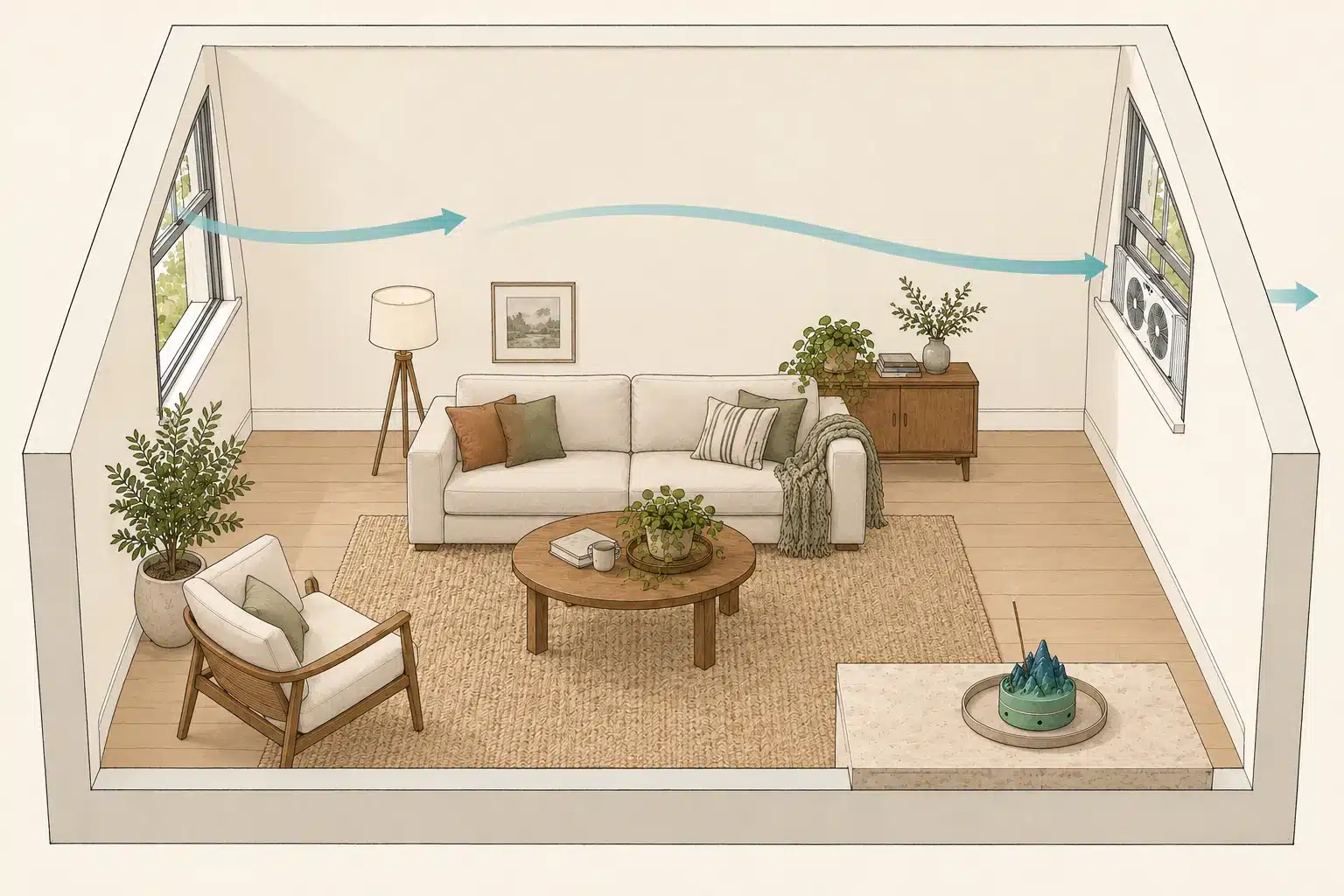
If weather and safety conditions allow, windows on different sides of a room, or a window and another exterior opening, can provide a route for air exchange. Keep the burner away from the spot most exposed to the draft between them.
Secure the windows or doors and keep curtains from blowing into the room. Then choose a stable surface for the burner that does not block a walkway or sit directly in the incoming air. Two openings give you more layout options, but their presence alone does not establish how much air the room exchanges.
When Only One Window Opens
Having only one window that opens does not necessarily mean there is no air exchange. It also does not mean a small crack will be enough for every room. If a fan is exhausting air, consider where replacement air will enter.
That route may pass through an adjoining room, but it still needs a connection to the outdoors. If the other openings are closed and you do not know how the room is ventilated, do not assume the combination of an open window and a running fan is sufficient. CDC/NIOSH guidance on air circulation explains why outdoor openings and the room’s layout matter.
Choose the Fan Direction Before Choosing the Burner Position
A desk fan, circulating fan, or ceiling fan mainly moves air around the room. If there is no exchange with the outdoors, a spinning fan does not establish that incense smoke is being removed.
One arrangement described in CDC/NIOSH’s window fan guidance uses a fan secured in a window to exhaust room air outdoors, with other openings allowing air in. When applying that general layout to an incense space, follow the fan’s installation instructions. Do not balance an ordinary desk fan on a windowsill, or arrange the airflow to carry smoke from the burner directly toward someone’s face.
Do not add a high-powered exhaust system just to move air faster. The EPA warns that strong exhaust with too little replacement air can cause backdrafting in appliances that rely on natural draft. This can draw combustion gases back into a home. If you have that type of gas water heater or furnace, have a qualified professional check the setup before adding exhaust equipment.
Place the Burner After Checking the Room
Use this sequence to think through your arrangement before lighting incense. It brings together general ventilation and fire safety guidance; it is not a measured ventilation plan for a particular home.
- Arrange the windows and fan first. Identify the outdoor openings, confirm that the fan is set to exhaust, and leave a route for incoming air. Do this before lighting the incense.
- Choose a suitable surface for the burner. Use a compatible heat-resistant holder on a stable, heat-resistant surface, away from curtains, paper, and other materials that can burn. Avoid windowsills you need to reach across and places where someone could knock the burner.
- Check where people will sit. Avoid an arrangement that sends smoke from the burner straight toward a person’s face. Stay with burning incense. If the burner needs moving, extinguish the incense fully and let the holder cool before adjusting it.
For example, a living room with two windows might have a window fan exhausting on one side and an incoming air opening on the other. The burner can sit on a stable side table outside the direct draft between them. This is a layout example, not a fixed distance rule: the room, wind, and equipment still matter. The London Fire Brigade’s incense safety advice also emphasizes stable heat-resistant holders, separation from flammable materials, and staying with burning incense.
Do Sticks, Coils, and Backflow Cones Need Different Ventilation?
None of these forms should depend on keeping a room closed. A different shape does not, by itself, establish that less ventilation is needed. For lighting instructions, see our guide to lighting sticks, coils, and backflow cones. This article focuses on arranging the room before and after use.
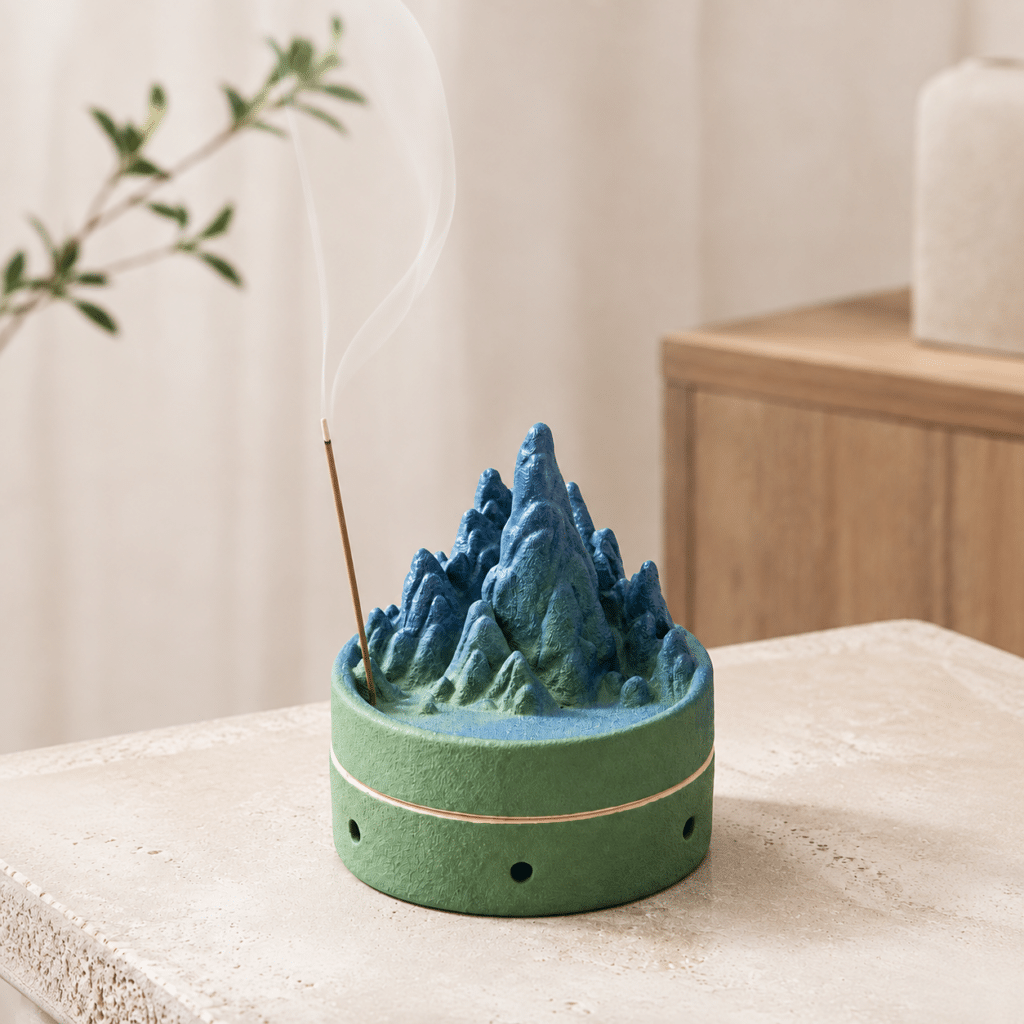
Backflow incense adds another consideration: a direct draft can interfere with the visible smoke flow. For example, the care instructions for our Misty Peaks 3-in-1 Ceramic Incense Burner call for keeping it away from fans, air-conditioning outlets, and strong drafts. The flow also varies with indoor airflow, the cone’s condition, and the cleanliness of the smoke channel. That is a placement limitation for the burner, not a reason to stop ventilating the room.
If a draft disrupts the effect, extinguish the incense before trying a position with less direct airflow. Do not seal the room to preserve a complete smoke waterfall. If the layout cannot accommodate both ventilation and suitable burner placement, accept an incomplete display or leave the incense unlit. Our backflow incense burner guide explains the burner mechanism and cone compatibility.
When Can You Close the Window After Burning Incense?
The moment the incense finishes is not necessarily the moment the room’s air has been renewed. If outdoor conditions remain suitable, keep air exchanging afterward and adjust for the weather, equipment, and room.
There is no universal rule such as leaving the window open for ten more minutes. Window openings, layouts, and exhaust conditions differ. A timer cannot establish that the air has cleared, and a fading scent is not a substitute for checking the ventilation arrangement. Before leaving the room or going to bed, make sure the incense is completely extinguished. Do not leave it burning unattended while you wait for it to finish.
Two Other Questions About Room Ventilation
Can You Burn Incense in a Room Without a Window That Opens?
A room without a window you can open may still have mechanical ventilation. What matters is whether the system introduces outdoor air or exhausts indoor air outdoors. If all you can identify is an air conditioner or circulating fan and the air exchange is unclear, leave incense unlit in that room. Ask the building manager or a ventilation professional to clarify the system if needed.
Can Air Conditioning or an Air Purifier Replace an Open Window?
It depends on the system. As the EPA explains about residential ventilation, many home heating and cooling systems do not mechanically bring outdoor air inside. Check what your equipment actually does; an air conditioner running is not proof of outdoor air exchange.
An air purifier can be a supplement, but it does not establish that the room is suitable for burning incense. The EPA’s home air filtration guidance describes filtration as a supplement to source control and ventilation, and notes that air cleaners cannot remove every pollutant.
Before your next session, check the windows, fan, burner, and seating together. Is there a route for outdoor air exchange? Will the burner avoid a direct draft? Can someone stay with the incense while it burns? If the ventilation arrangement is not suitable, leave the incense unlit.
Share Your Room Setup
Do you use incense in a room with one window, two windows, or mechanical ventilation? Is finding a place for the burner or choosing the fan direction the harder part? Share your setup in the comments.
 VIEW PRODUCT
Leave a Comment
All fields are required
Your comment will appear after approval