



A backflow incense burner is designed for a special type of cone with a hollow channel inside. When the opening in the cone is centered over the burner’s inlet, some of the smoke can leave through the bottom and follow the burner’s steps, grooves, or sculpted path. That creates the familiar waterfall effect.
The burner does not pull smoke downward, and not every wisp will fall. A little smoke may still rise from the tip. The result depends on four things working together: a true backflow cone, clear and aligned openings, a stable ember, and calm air around a level burner.
What makes a backflow incense burner different?
A backflow burner is built around a smoke route. The cone platform normally has an inlet, with a visible route below it that guides descending smoke. A regular incense holder mainly supports stick incense, coil incense, or a solid cone and catches ash. It may not have a connected inlet or a path for smoke to travel down.
| Feature | Räucherwerk mit Rückfluss | Regular incense holder |
|---|---|---|
| Main incense type | Backflow cone with a hollow channel | Stick, coil, or regular cone, depending on the holder |
| Typical visual effect | Some smoke exits at the base and moves down the designed path | Smoke usually rises from the burning point |
| Alignment requirement | The cone opening must meet the burner inlet | Usually does not depend on two aligned openings |
| Sensitivity to drafts | High; direct airflow can break up the cascade | Airflow still matters, but there is no cascade to maintain |
| Cleaning focus | Ash, the inlet, and surfaces along the smoke path | Ash tray, support, and burning area |
Some burners support more than one incense form. Check the product description rather than judging from the shape alone. If your main goal is the descending smoke effect, compare products that are specifically listed for backflow incense cones. If you also use sticks or coils, confirm where each form belongs and whether the manufacturer lists that use.
You may also see the names waterfall incense burner or incense waterfall. The label can vary, but the functional checks are the same: the cone needs a hollow passage, the burner needs a connected inlet, and the product instructions should state that it accepts backflow cones.
Wie funktioniert ein Rückfluss-Räuchergefäß?
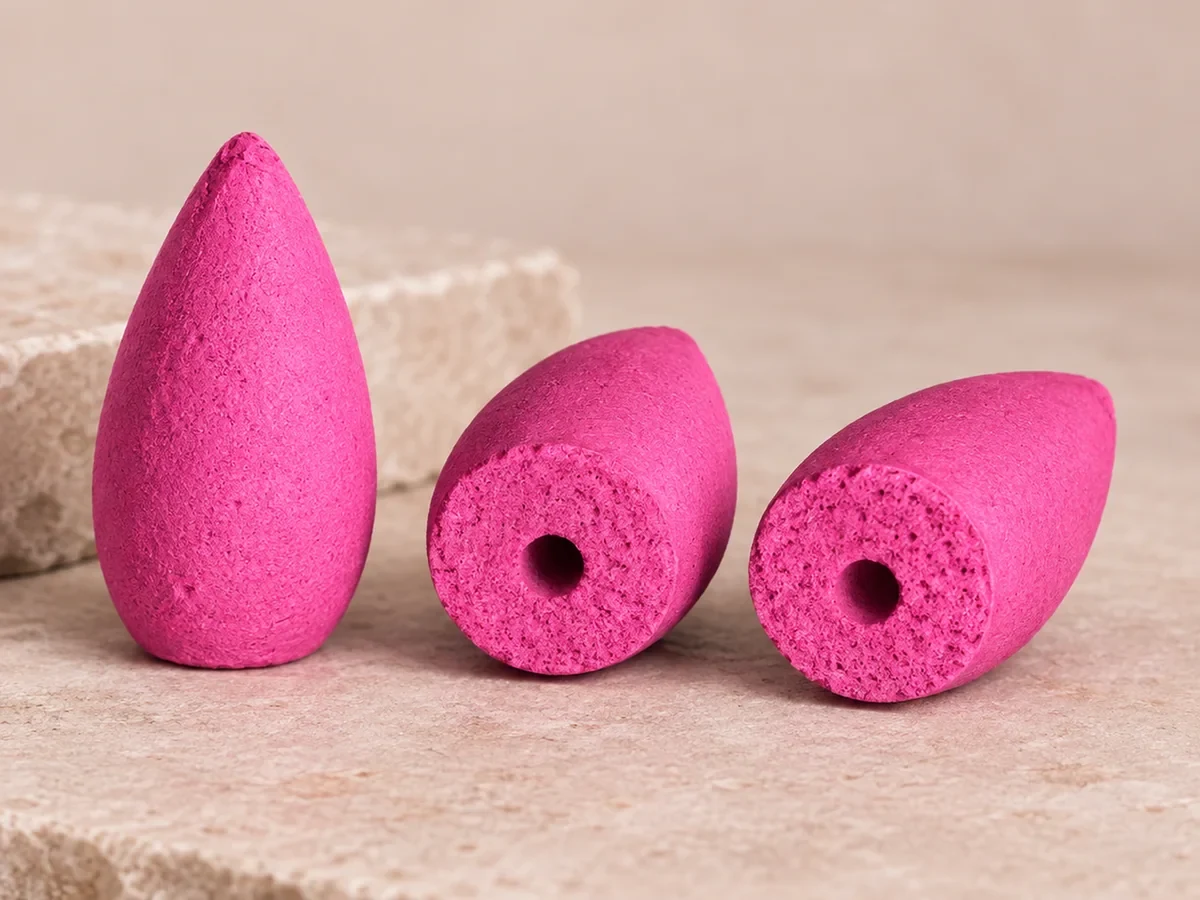
A backflow cone has a hollow channel
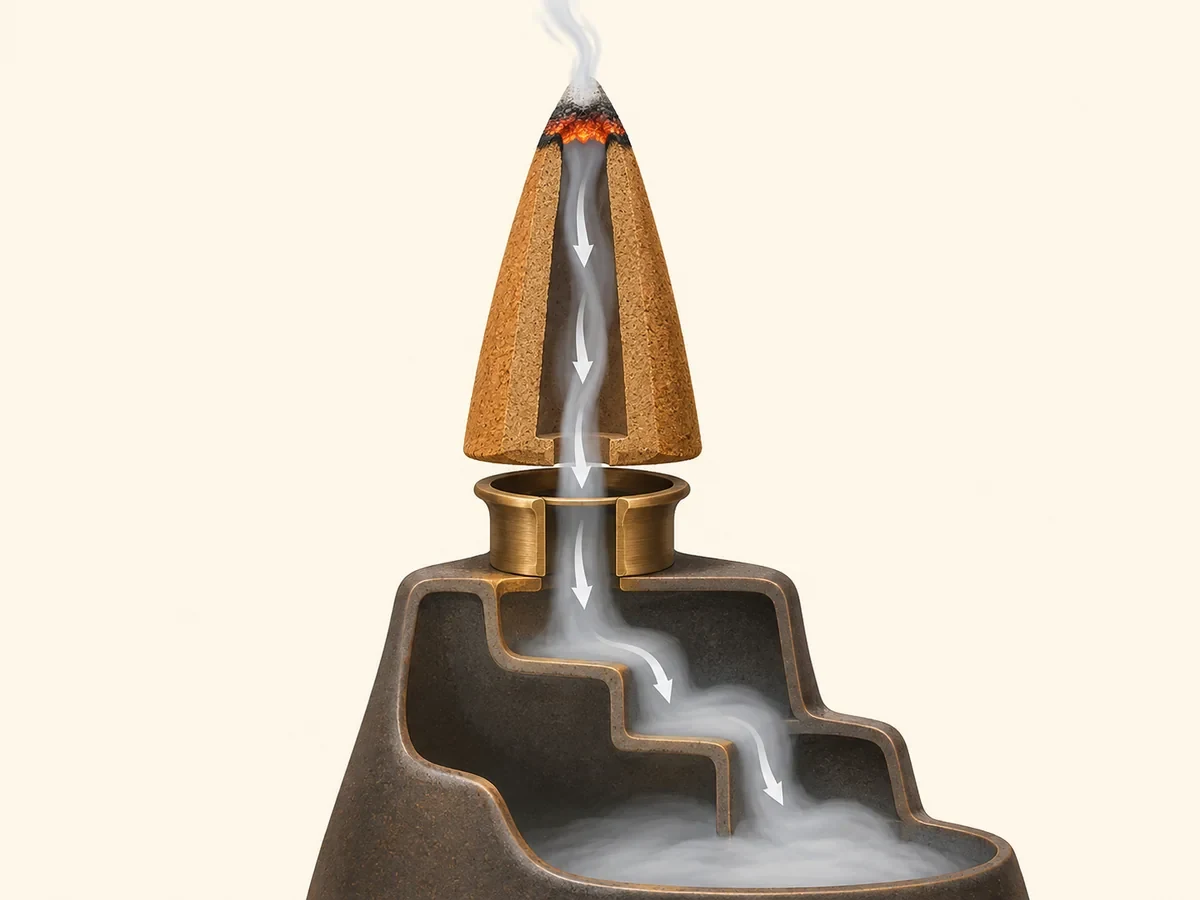
The important difference is inside the cone. A backflow cone has a hollow passage that opens at the base. Once the tip develops a steady ember, some smoke can enter that passage and leave through the lower opening. A solid cone does not provide the same route, so placing one on a backflow burner usually will not create a complete cascade.
The two openings need to meet
After smoke leaves the cone, it needs a clear route into the burner’s inlet. If the cone is off-center, ash blocks either opening, or the base rests across only part of the inlet, smoke can escape around the sides instead of entering the designed path.
The channel and convection both affect the flow
Warm air generally rises while cooler, denser air can sink. NASA’s explanation of convection describes this basic relationship between warm rising air and cooler sinking air.
Applied carefully to a backflow burner, the hollow channel gives some smoke a lower exit. If the smoke-and-air mixture cools enough by the time it reaches that opening, it may descend into the burner’s path. The burner guides the smoke; it does not create suction.
This is a structural explanation based on general convection, not a laboratory result for every cone formula. MORI TASTE has not measured the temperature or density inside these cones. Cone composition, channel size, burn quality, alignment, and room airflow can all change the result.
Even a small draft can disturb the cascade
Backflow smoke moves slowly. A ceiling fan, air-conditioner vent, strong air purifier, open window, or someone walking close to the burner can push the stream sideways. Keep the room ventilated, but place the burner outside the direct path of moving air.
How to use a backflow incense burner
- Choose a stable location. Set the burner on a level surface where it cannot rock or tip. Keep paper, curtains, bedding, books, and other flammable items well away.
- Use a true backflow cone. Turn the cone over and check for a clear opening in the base. A regular solid cone may burn, but it normally will not produce the intended waterfall effect.
- Inspect the burner inlet. Before lighting anything, remove old ash and loose residue. Make sure the opening is clear.
- Center the cone over the inlet. The cone should sit flat, with its opening centered over the burner’s opening. Do not pack ash or other material into the gap.
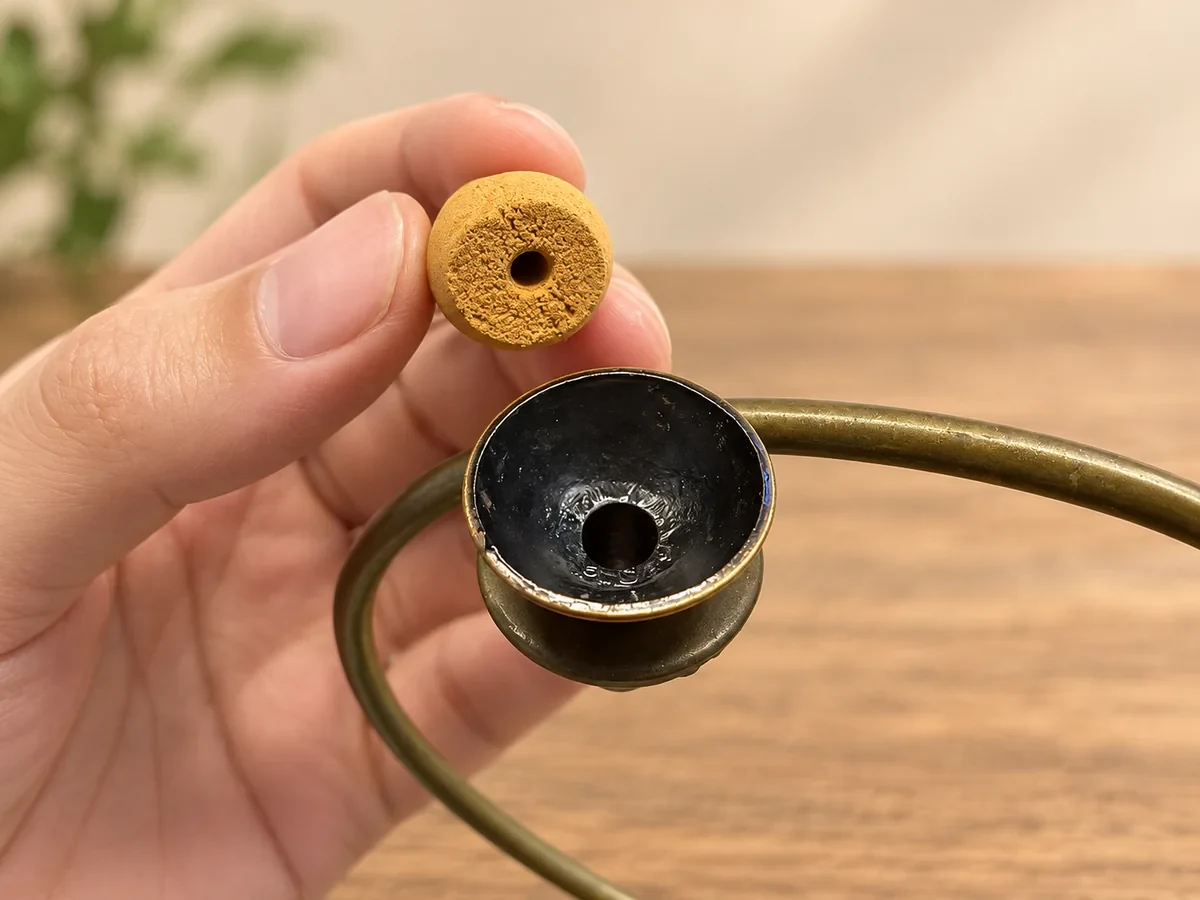
Instructional image based on the actual cone and burner inlet structure. - Light the cone according to its packaging. Let the tip catch, then extinguish the flame as directed so a steady glowing ember remains. The backflow effect may take time to develop; the timing varies with the cone and its burn condition.
- Watch where the smoke exits. A small plume above the cone does not automatically mean something is wrong. Look for a steady stream at the base and check whether it enters the burner path.
- Stay with the burner. Extinguish the cone before leaving the room or going to sleep. Confirm that the ember is out, then allow the burner to cool before moving or cleaning it.
Why is the smoke not forming a waterfall?
| What you see | Likely causes | What to check first |
|---|---|---|
| Smoke only rises | Solid cone, blocked base opening, or poor alignment | Check the cone opening, then center it again |
| Smoke appears below but quickly disperses | Direct airflow from a fan, vent, window, or nearby movement | Remove the direct draft while maintaining general ventilation |
| Smoke travels down one side | Uneven surface, tilted burner, or residue on one side of the path | Level the burner and clean it after it cools |
| The cone goes out | Ember was not established, airflow is restricted, or the cone is not compatible | Follow the cone instructions, clear the openings, and try a compatible cone |
| The flow starts and stops | Changing burn conditions, ash entering the opening, or repeated air disturbance | Do not move the burner while lit; clear drafts and clean it when cool |
| The room becomes too smoky | Poor ventilation, a small room, or too much incense burning at once | Extinguish the cone, ventilate the room, and use less next time |
If a compatible cone still will not produce backflow after you clear and align the openings, level the burner, and remove direct drafts, stop relighting it repeatedly. Check whether the burner route is actually open, then consult the product instructions or ask the seller about compatibility.
How to choose a backflow incense burner
Check compatibility before style
The product page should state which incense forms the burner accepts. For a waterfall effect, look for explicit support for backflow cones. If you also want to burn sticks or coils, choose a model that identifies separate, suitable positions for those forms.
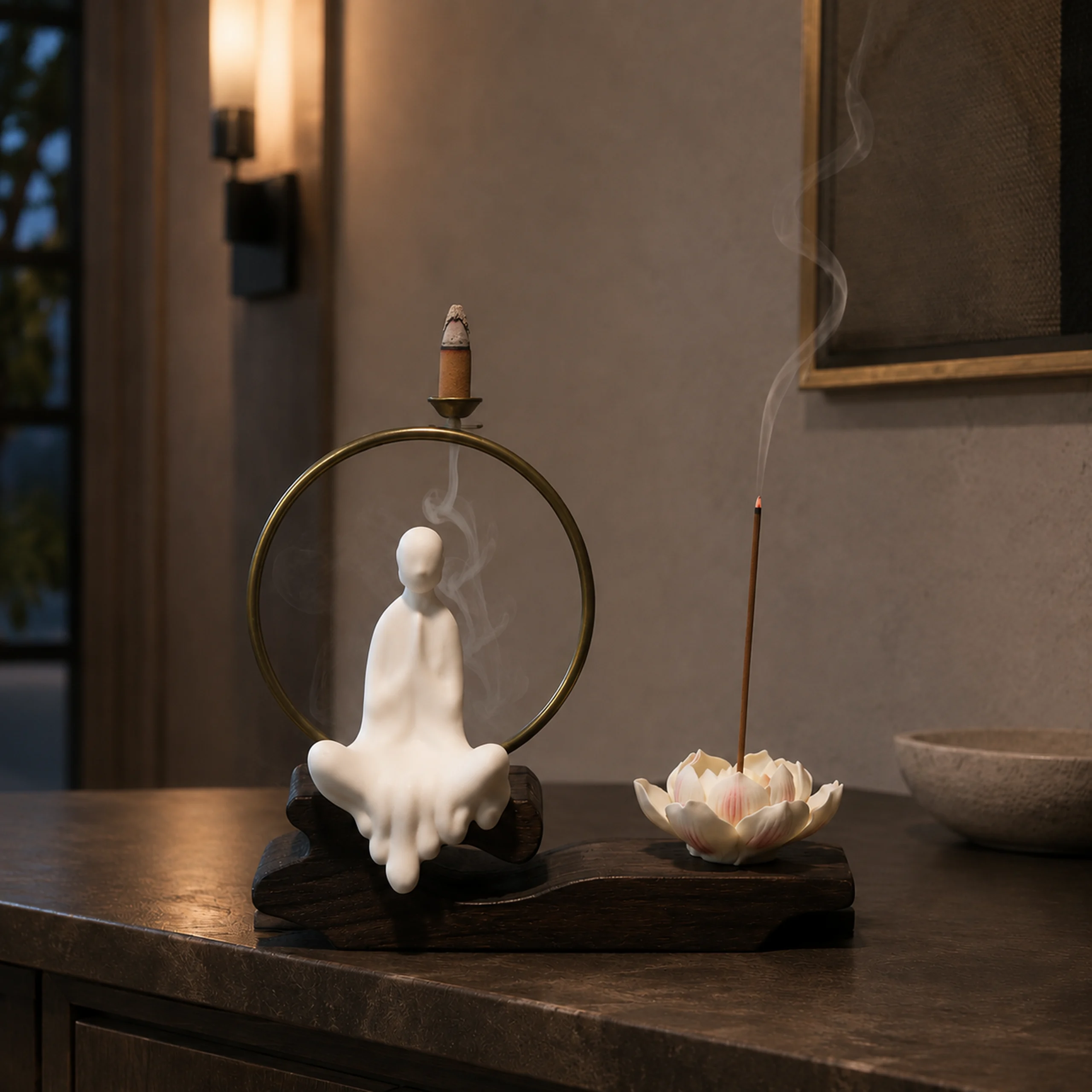
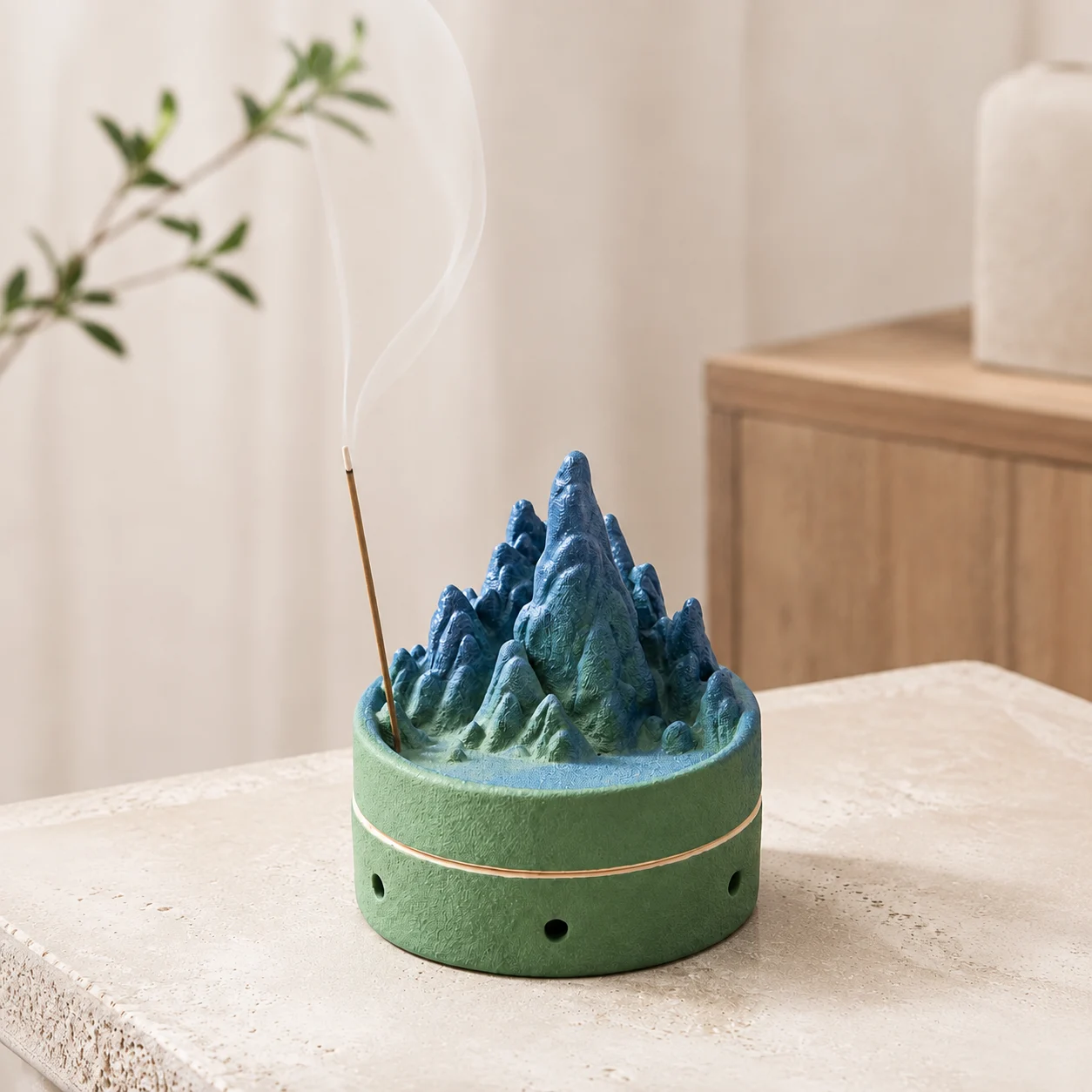
For example, MORI TASTE’s Circle of Stillness lists a backflow-cone platform and a lotus stick holder. Misty Peaks lists positions for backflow cones, sticks, and coils. These are examples from MORI TASTE’s own catalog, not independent rankings. Follow the current instructions on each product page.
Look for a path you can inspect and clean
Smoke residue and ash will collect along the route over time. Open steps are usually easier to see and wipe. With deep, covered, or complex designs, check whether the areas that need cleaning are accessible. Do not force apart a piece that the manufacturer does not describe as removable.
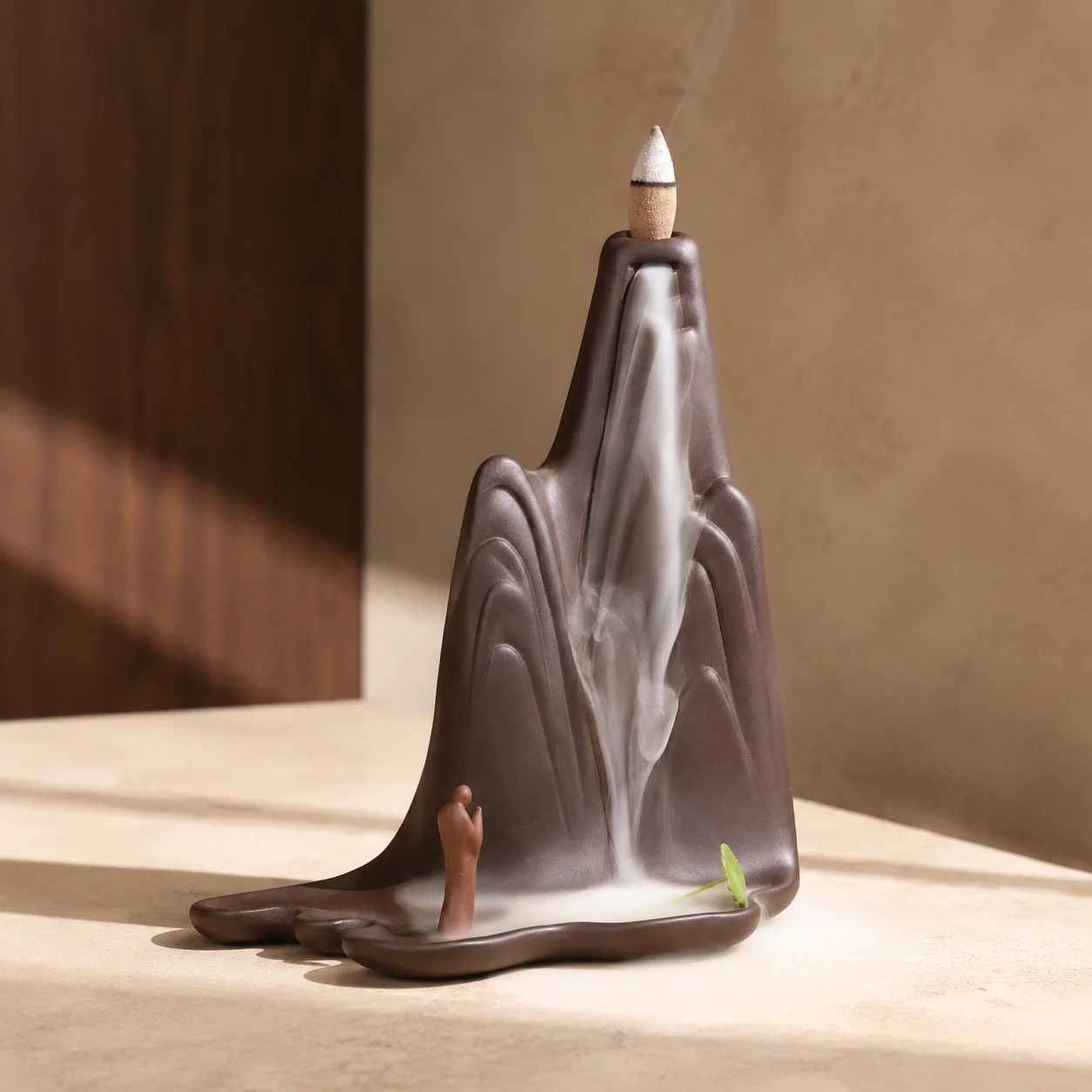
Mountain Stream is one example of a burner whose product page emphasizes a visible, mountain-shaped smoke route.
Check stability and the burning position
The base should sit flat on a level surface, and the cone platform should not be so narrow that a small bump could dislodge the cone. Do not infer heat resistance, cleaning methods, or water resistance from the appearance of ceramic, wood, or metal. Use the instructions for the specific product.
How to clean a backflow incense burner
Wait until the cone is fully extinguished and the burner is cool. Empty loose ash, then use a soft, dry cloth to wipe the inlet and the surfaces touched by the smoke. If dry wiping does not remove the residue, check the product’s material and care instructions before using a damp cloth or cleaner.
Do not soak the burner unless its instructions specifically allow it. Do not use a sharp tool to enlarge the inlet. Either action can damage a finish, change the opening, or affect wooden, coated, bonded, or mixed-material parts.
Backflow incense burner safety
Backflow smoke is still combustion smoke, not water vapor. The U.S. Environmental Protection Agency identifies candles and incense as indoor sources of particulate matter and recommends adequate ventilation when burning them indoors.
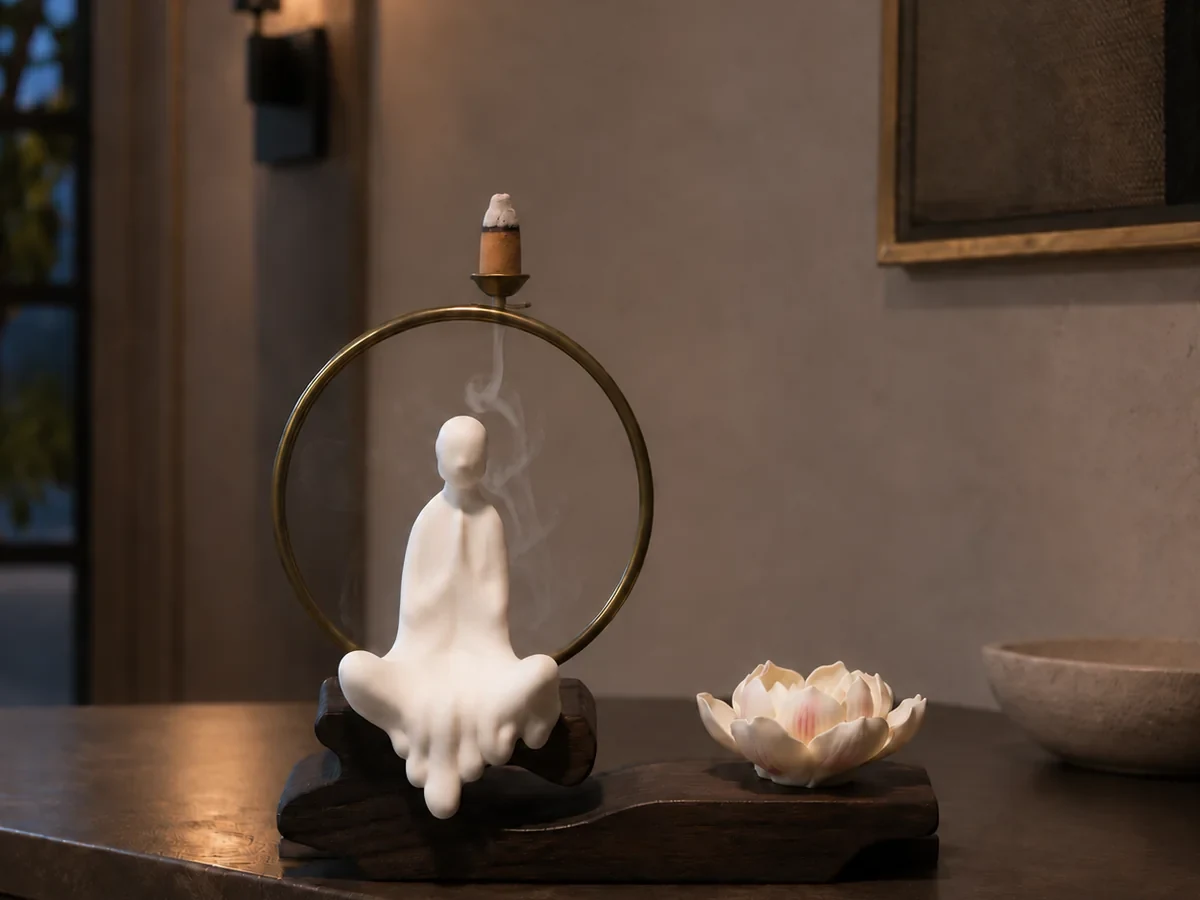
The Seattle Fire Department’s incense safety guidance advises keeping burning incense attended, extinguishing it before leaving or sleeping, and keeping it away from furniture, curtains, bedding, carpets, books, paper, and other combustible materials.
In practice:
- use a stable surface appropriate for the specific burner’s heat and care instructions;
- keep the burner out of reach of children and pets;
- never burn incense while sleeping, away from home, or without supervision;
- ventilate the room without aiming a draft at the burner; and
- wait until both the cone and burner are cool before handling ash.
Frequently asked questions
Can I use a regular incense cone on a backflow burner?
A regular cone may burn in a cone-safe position, but without a hollow base channel it will not create the designed downward flow. Confirm that the burner’s instructions allow regular cones before using one.
Why does the backflow smoke take time to appear?
The cone needs a stable ember before smoke can move consistently through its inner channel. Check the ember, clear both openings, and center the cone. Avoid repeatedly moving a burning cone just because the cascade does not appear immediately.
Should I add water to the pool at the bottom?
Only if the product instructions specifically require it. A basin-shaped area is often part of the visual smoke path rather than a water reservoir. Materials and construction vary, so do not add water based on appearance alone.
Will an open window stop the backflow effect?
Ventilation is useful, but a draft aimed at the burner can scatter the slow-moving smoke. Keep air circulating in the room while moving the burner away from the direct path of a window, fan, or vent.
A reliable cascade starts with four checks
A backflow incense burner works best when four conditions meet: a cone with a clear hollow channel, openings that line up, a level and unobstructed smoke route, and calm air around the burner. Once you understand those checks, it becomes easier to tell whether a weak cascade comes from the cone, the burner, or the room.
Explore MORI TASTE Backflow Incense Burners or shop Backflow Incense Cones when you are ready to compare compatible options.
What happens most often with your burner: smoke rising from the top, a broken cascade, or a cone that will not stay lit? Share the cone and burner structure in the comments.
 PRODUKT ANSEHEN
 PRODUKT ANSEHEN
 PRODUKT ANSEHEN
Leave a Comment
All fields are required
Your comment will appear after approval